RIVERBOARDS ⟋ GEAR, FROM THE RIVER
Is a rescue board good for riverboarding?
Carlson foam board vs plastic whitewater riverboards

SHORT ANSWER
Yes, you can riverboard on a rescue board like the Carlson River Board. It's a light, very buoyant foam board, and it's a proven swiftwater rescue platform [1][2]. For creeking and steep, technical downriver runs, a purpose-built plastic hydrospeed-style riverboard gives you more control, protection and a better chance of staying on your board in holes and below drops. That's because of how it holds your body and how it carries its weight, not because foam is "bad" [9].
IN THIS ARTICLE
- What is a rescue river board?
- Can you riverboard on a Carlson?
- Foam vs plastic riverboards: what's the real difference?
- Rescue foam board vs plastic whitewater riverboard: side by side
- What to look for in a creeking riverboard
- What happened to the Fluid Anvil?
- Where do Ripboards and foam hydrospeeds fit?
- Where the Tana fits
- FAQ
What is a rescue river board?
A rescue river board is a big, flat, high-flotation board that a swiftwater rescuer lies on and kicks with fins to reach someone in the water. The best known is the Carlson River Board. NRS sells it in its rescue range, and it pitches the board both to rescue pros who need a swiftwater platform and to people who just want to play on the river [1].
The numbers, from NRS [1]:
- Foam construction with a slick, smooth bottom; the foam won't absorb water [1].
- 56 x 24 x 4 inches, 10 lb.
- 165 lb of flotation.
- Two sets of handles, so two people can hang on at once.
- Neon green bottom for visibility.
- 3-year warranty against delamination.
- $580 plus a $50 oversize surcharge at NRS (October 2026).
Rescue teams rely on it. Sierra Rescue International reports river boards in use with the US Border Patrol's BORSTAR unit, the National Park Service and Yosemite search-and-rescue rangers, and treats board rescue as a technician-level skill that can meet the NFPA 1670 requirement for a rescue from a platform [2].
The design goes back to the early 1980s, when California surfer Robert Carlson made a thicker, longer bodyboard with four handles for the river [5][3]. Back in 2005 we wrote on facelevel.com that it was "by all accounts the most widely used riverboard (in North America at least)" [4]. Its job hasn't changed much since: float a person high and steady in moving water, and give them plenty to hold on to.
Can you riverboard on a Carlson?
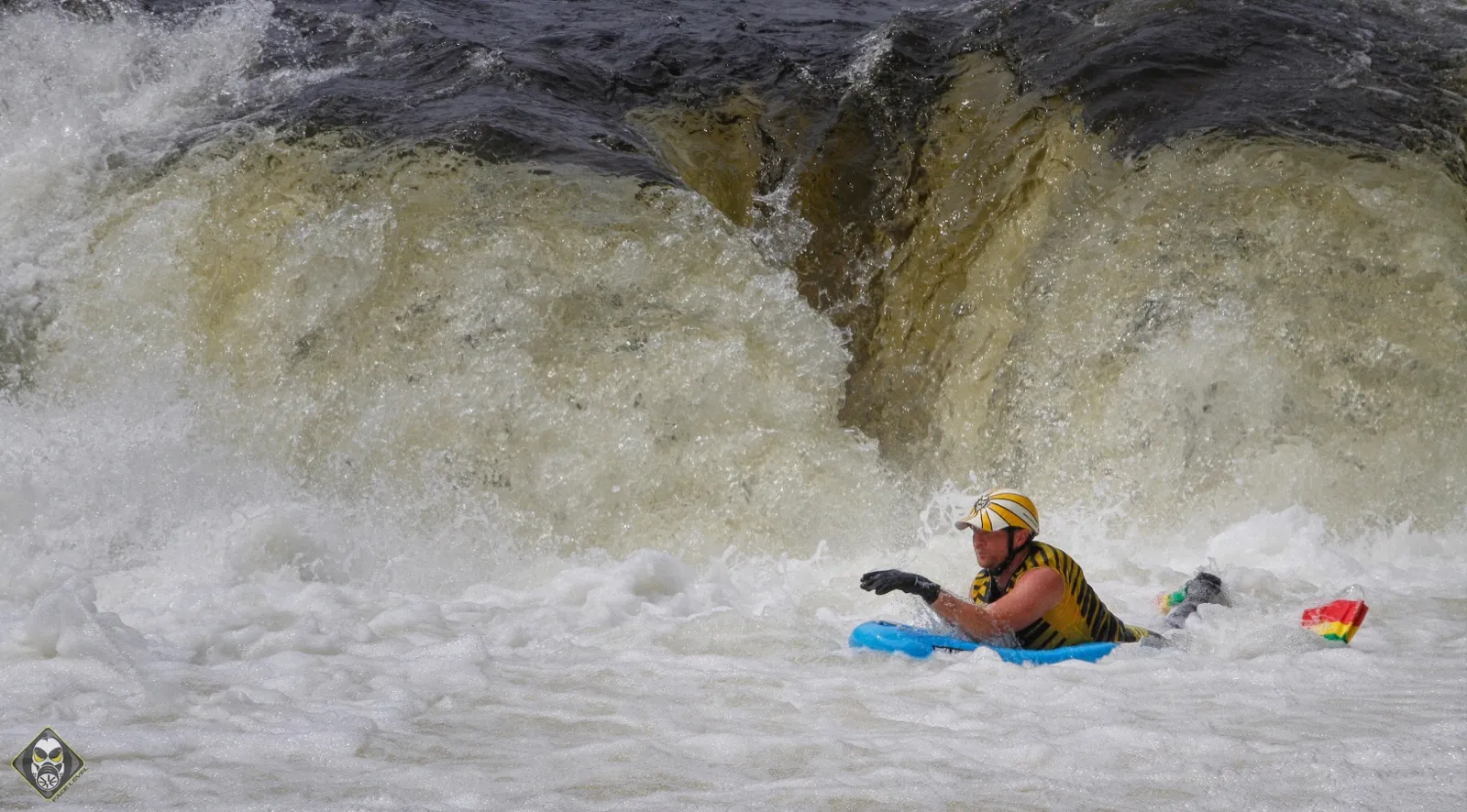
Yes. Plenty of people have learned on one, and guides and recreational riders have used Carlsons for decades [3]. I've recommended it myself. In 2012, writing for adventure racers who might face long flatwater stretches and big rapids, I told them to take a Kern or a Carlson, because flat foam boards "have ample flotation and enough length that you can hand-paddle them like a surfboard with good speed," and because they're much lighter to carry on portages than a plastic board [11].
That's what a flat foam board is good at:
- Float. 165 lb of flotation keeps you high in the water [1].
- Flatwater and long days. It's long enough to hand-paddle like a surfboard [11].
- Carrying. At 10 lb it's light on a hike-in [1].
- Surfing. Flat foam boards surf river waves well. In my 2012 Anvil review I said a plastic hydrospeed probably isn't as versatile on a wave "as a Kern, Carlson, or bodyboard" [9].
- Rescue. It's built as a rescue platform first [1][2].
Where it comes up short is the steep stuff. Back in 2012 I described three distinct kinds of riverboard: "boogie boards (deep water and surfing), flat-bottom foam boards (Kern & Carlson et al, surfing and river running) and hydrospeeds (river running and creeking). All have their place" [10]. Creeking is where the hydrospeed shape earns its place, for the reasons below.
Foam vs plastic riverboards: what's the real difference?
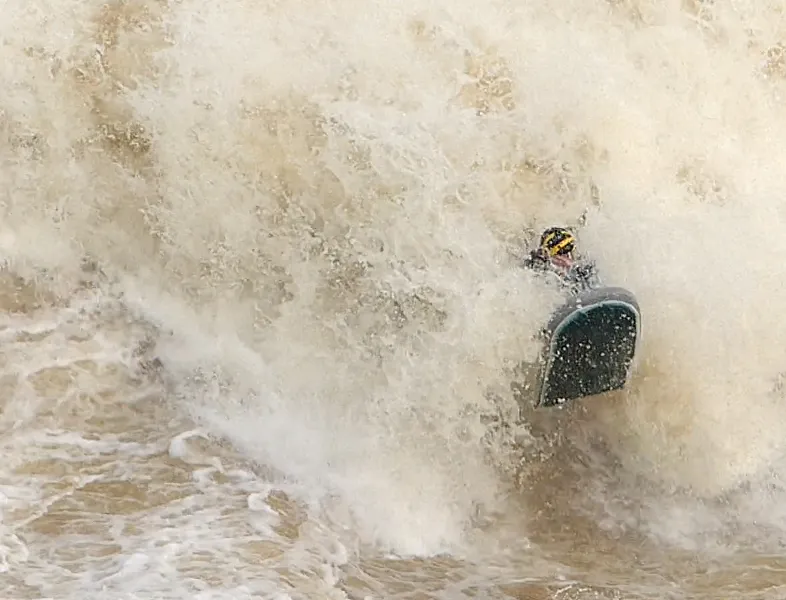
Plastic came first, and foam was the fix for a real problem. The French started the sport in the late 1970s [5]. Their first hydrospeeds were hard-plastic shells, and riders kept hitting each other in the face and teeth in the holes, so the French switched to foam hydrospeeds to cut weight and stop the injuries [5][6]. New Zealand kept a hard-plastic shell, the sledge [6]. Ripboard, a Colorado company started in 1999, built its molded plastic boards on that New Zealand sledge design [6][7][8].
So the question was never really foam or plastic. It's which kind of board fits the water you run. I put it this way in 2012: "Different rivers and different goals in the river, call for different boards" [12].
On a steep creek, these are the things that change how a board rides:
1. Weight against buoyancy. It sounds backwards, but more float isn't always better. In my experience the more buoyant and the lighter the board, the worse things went in a big hole [9]. Too little float and you get to know the bottom of the river. Too much and you're the laundry. The Fluid Anvil weighed 9 kg (20 lb) out of the water, yet floated an average rider at about the same level as a foam hydrospeed. That weight helps you drive through a hole instead of bouncing on top of it [9]. A 10 lb board with 165 lb of flotation [1] is at the light, buoyant end of that range. That's ideal for staying on top of the water during a rescue, and it's a handful in a hole.
2. Handle position. A flat board puts your hands forward, palms down. That means you steer with your forearms and wrists, the weakest muscles in your upper body. I've been saying this since the first day I rode a Carlson [9]. The Anvil's vertical handles let you steer with your lats, like holding the yoke of a fighter jet, and that control matters most when you're falling off something tall [9].
3. Contact with the board. On a flat board you lie on top. In a hydrospeed shape you lie inside it, with contact on three sides of your body. When a hydraulic grabs you, the more of you that's touching the board, the better your chance of surfacing with the board still under you and in position for the next move [9].
4. Rolling. Upside down is the one position where you'll fall off any riverboard. In the hands-forward, palms-down position most boards are very hard to roll [9]. A hydrospeed shape with good handles can be rolled up [9]. I've used that roll to take a rock hit on the bottom of the board, drop into the hole and come up still riding [34].
5. Sliding on rock. A hard, smooth plastic hull slides over rock, and it has just enough flex to give you a bit of bounce when you boof [9]. The foam hydrospeed I built and rode for almost five years was the best board I'd had until then, but its soft foam and rubber hull didn't slide or boof on rocks. It was also very light and very buoyant, so sometimes I chose lines based on what the board could handle, not on what I could run [9].
6. Protection. A plastic shell with sidewalls puts plastic between you and the rocks [15]. The trade-off is the same one the French ran into: hard plastic is hard on whoever it hits. That's one reason the Anvil kept a rounded nose instead of a creekboat point. It had to stay safe for guides putting newcomers on it [9].
7. Weight on land. Plastic boards are heavier to carry. The Tana is 8 kg (18 lb) [17][19], about 8 lb more than the Carlson's 10 lb [1]. Nobody complains about carrying a creekboat.
Rescue foam board vs plastic whitewater riverboard: side by side
| Rescue foam board (Carlson River Board) | Plastic hydrospeed-style riverboard (LEKKER Tana; Fluid Anvil for reference) | |
|---|---|---|
| How you ride it | Lying on top of a flat board | Lying inside a shell, with contact on three sides [9] |
| Construction | Foam with a slick, smooth bottom [1]; we described it in 2005 as thick ethafoam with a thin plastic skin underneath [4] | Plastic hull [14][17]; the Anvil was rotomolded from kayak plastic [9] |
| Size | 56 x 24 x 4 in [1] | Tana 122 x 61 x 30 cm (48 x 24 x 12 in) [17][19]; Anvil 110 x 64 x 30 cm [14] |
| Weight | 10 lb [1] | Tana 8 kg / 18 lb [17][19]; Anvil 9 kg / 20 lb [14] |
| Buoyancy | 165 lb flotation [1] | Not published. In my experience the Anvil floated an average rider about like a foam hydrospeed [9] |
| On rocks | Slick bottom, 3-year delamination warranty [1] | Hard hull slides over rock and gives a little pushback to boof [9]; "made to take a beating" [15] |
| Steering and edge control | Handles forward, palms down: forearm and wrist control [9] | Vertical / pistol-grip handles you steer with your back and arms [9][19] |
| Staying on, rolling | Hard to roll in the hands-forward position [9] | Built to surface and roll with the rider in it [9] |
| Protection | Soft foam; no sidewalls | Shell and sidewalls between you and the rock [15]; a hard shell can hurt a partner in a collision [5][6] |
| Hand-paddling, flatwater | Long and flat, hand-paddles like a surfboard [11] | Harder on the Anvil [9]; the Tana lowers its middle sidewalls so you can swim your arms [19] |
| Built for | Swiftwater rescue platform and recreational play [1] | Creeking and technical river running [14][15] |
| Price | $580 + $50 oversize surcharge at NRS, Oct 2026 [1] | Tana: final price set before production; a $100 deposit holds one [19] |
What to look for in a creeking riverboard
Whatever brand you ride, these are the things I check on a board I'm going to take down a steep creek.
- Weight-to-buoyancy balance. Heavy enough to drive through holes, buoyant enough to come back up fast [9].
- A nose that punches. Pointed enough to pierce a hole, round enough not to injure the rider next to you [9].
- Handles that use your strength. Vertical or pistol grips you steer with your lats, not your wrists [9].
- Lock-in. Contact on your sides as well as your chest, so the board stays with you underwater [9].
- Rollable. You should be able to roll it up without letting go [9].
- A hull that slides. Hard and smooth on the bottom, with a little flex for boofing [9].
- Fit. Designer Charl van Rensburg sized the Anvil so most riders' elbows sit on the board's centre line, which keeps it floating level and planing [13]. If your elbows end up well forward or back of that line, the board noses down or drags.
- Room to hand-paddle. You'll use your hands to ferry, line up and catch eddies.
- Your own armour. The board is only part of the protection. For creeking I wear a full-face helmet, hard-shell upper-body protection and hard knee and shin pads, plus fins, webbed gloves, a high-float PFD and a wetsuit [24]. Never ride beyond your ability, never ride alone, and go with someone who knows the river [25]. A swiftwater rescue course is worth more than any board.
What happened to the Fluid Anvil?
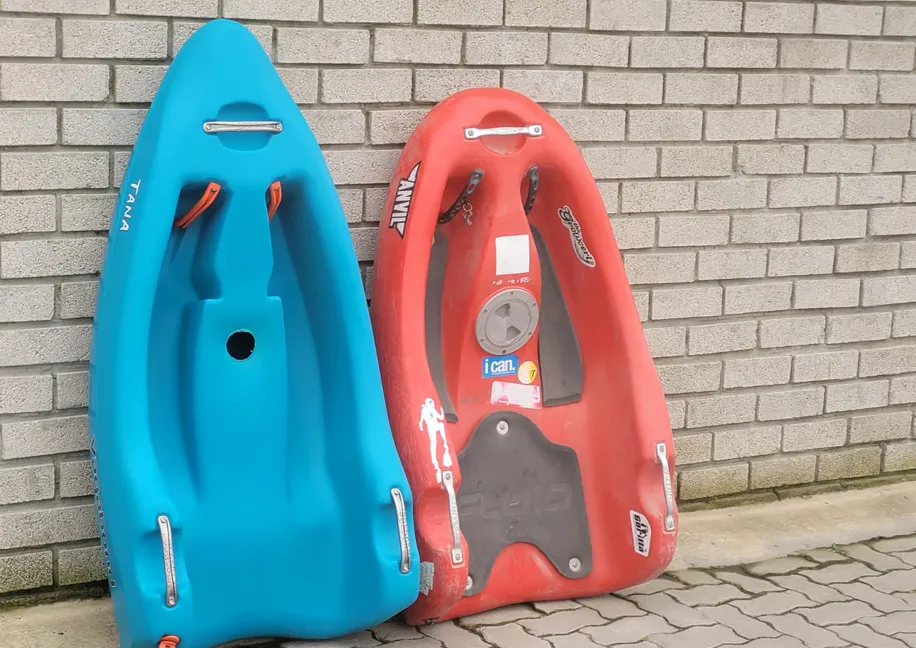
The Fluid Anvil was the plastic hydrospeed many of us had wanted for years [30]. Charl van Rensburg designed it with Celliers Kruger, then the owner of Fluid Kayaks in South Africa [13][30][26]. It came out in 2011–2012 [17][13]. I outfitted the first Anvil molded in the USA at Fluid's factory in March 2012 [31], and Asaf Arad and I rode Anvils for many years [26]. Its product description calls it "first and foremost a creeking board" [15].
Here's what happened next:
- Its designer moved on. Celliers Kruger went on to found Vagabond Kayaks and then LEKKER Kayaks in 2024 [18].
- The Anvil's successor comes from the same designer. Celliers brought back riders who had spent years modifying their own Anvils (Charl van Rensburg, Asaf Arad and me) and started over. The result is the Tana, first announced in 2024 as the Vagabond Tana and now made by LEKKER [29][17][19].
If you're looking for a Fluid Anvil replacement, that's the board.
Where do Ripboards and foam hydrospeeds fit?
- Ripboard: Shane Bolling started Ripboard in Golden, Colorado, in 1999, after discovering the sport on a trip to New Zealand [8]. Its molded plastic boards were based on the New Zealand sledge [6][7]. In 2007 there were three models, from a thin-shelled 15 lb race board to a foam-filled 21 lb board named after the Gauley [7]. I listed Ripboard with the Anvil as the hydrospeed-style plastic option in 2012, and called it a legitimate riverboard in 2014 [11][28]. I couldn't confirm whether Ripboards are still being made today.
- Foam hydrospeeds: Still the most common board in Europe, and usually custom-made to fit the rider [27]. They're light and very buoyant. The drawbacks are the ones I wrote about with my own foam hydrospeed: a soft hull that doesn't slide or boof on rock [9].
Where the Tana fits
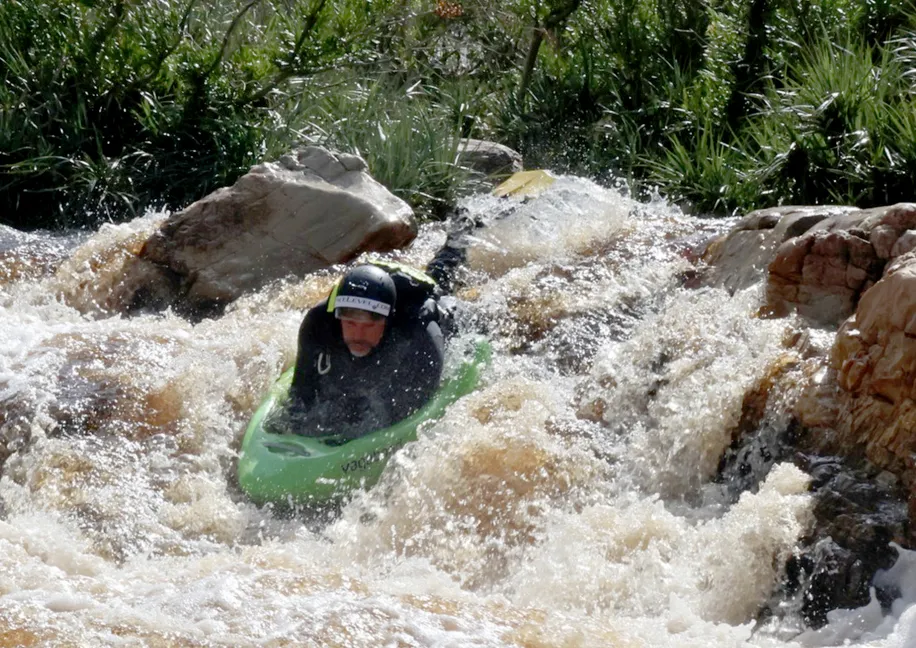
The LEKKER Tana is a plastic hydrospeed-style riverboard, designed by Celliers Kruger with Charl van Rensburg, Asaf Arad and me [17][19]. It's built for downriver and creeking. Celliers also designed the Lekker Petrel, which won the Recreational Product of the Year award at the 2026 Paddle Sports Show [20].
Measured from the production mold: 122 cm long, 61 cm wide, 30 cm high, 8 kg (4 ft x 24 in x 12 in, 18 lb) [19]. Compared with the Anvil it's narrower and longer, with a sharper bow carrying more volume behind it, a wider cockpit, tighter hips, no bump on the centre console, lower middle sidewalls for hand-paddling, pistol-grip handles and side indents to hold when you're surfing [19]. Colours: chartreuse, green, orange, blue, and two chartreuse blends [19].
Charl, the Tana's test pilot, compares it to the Anvil like this: "You can run a river with both — but there is a difference between driving and steering." [19]
The mold is ready. What it needs is riders. If 30 people put down a $100 deposit, the Tana goes into production for the 2027 season. Your deposit counts toward the board, final pricing is confirmed before production, and if the run doesn't reach 30, every deposit is refunded in full [19].
RESERVE A TANA FOR THE 2027 RUN→
FAQ
Is a rescue board a "real" riverboard?
Yes. It's the same sport whatever you ride or call it [6]. I've always counted the Carlson, Kern, Ripboard and Anvil as legitimate riverboards [28]. The difference is what each board is built to do.
Is a Carlson river board good for beginners?
It's a forgiving, very buoyant board, and outfitters and recreational riders have used it for decades [1][3]. Most riverboarders never run class V, and class III is plenty of fun on a riverboard [33]. Start with a guide or someone who knows the river [25].
What's the difference between hydrospeed and riverboarding?
None. It's one sport. Europeans call it hydrospeed, some New Zealanders call it sledging, and most English speakers call it riverboarding [5][6].
Can I use a boogie board in whitewater?
Not on rocky, technical rivers. A bodyboard has little flotation and no handles, and isn't built to support your full weight in rapids [32][11]. Never use a kid's foam boogie board [11].
Are plastic riverboards dangerous?
Hard plastic can injure you or another rider in a collision. That's why the French switched to foam [5][6], and why the Anvil was given a rounded nose [9]. Wear a helmet, leave space between riders, and pick a board with a nose shaped for that.
What replaced the Fluid Anvil?
Its designer's newer board is the LEKKER Tana, built with riders who spent years on Anvils [17][19].
How much does a creeking riverboard weigh?
The plastic boards here weigh 8–9 kg (18–20 lb) [14][17]. The Carlson weighs 10 lb [1].
About the author
Josh Galt founded Face Level Industries in 2003 [26]. He has riverboarded in more than a dozen countries since the early 1990s, with first riverboard descents including North Carolina's Green River Narrows, a high-water Kiyotsu river descent under snow bridges in Japan, and the 15 m Hollin Chico Falls in Ecuador [21][35]. He served two years as President of the World Riverboarding Association [21][22], created and directed the first two Riverboarding World Championships (Indonesia 2013, Guatemala 2015) [21][22][23], and sat on the committee behind the first international riverboarding guide certification through the IRF [21]. He was Water Director for two editions of Primal Quest and produced the riverboarding events at the final Gorge Games in 2008 [21]. In 2014 Gear Junkie named him one of its 110 Outdoor Ambassadors [21][22]. He rode the Fluid Anvil as a sponsored rider [9][30] and is on the design team of the LEKKER Tana [17][19]. More of his work is at joshgalt.com.
Sources
- NRS, "Carlson River Board" product page, accessed 2026-10-03. nrs.com/rescue/carlson-river-board/pk9u (Specs confirmed on NRS's previous-model page: nrs.com/product/18701/carlson-river-board)
- Abigail Polsby, "Carlson River Boards; An Excellent Rescue Tool," Sierra Rescue International, 2017-08-30. sierrarescue.com/carlson-river-board-an-excellent-rescue-tool/
- Face Level, "Carlson Riverboards," 2007-09-16. web.archive.org/web/20071204031113/http://facelevel.com:80/v3/index.php/Boards/Carlson-River-Boards.html
- Face Level, riverboard reviews, 2005. web.archive.org/web/20050310162636/http://www.facelevel.com:80/river_board_gear_reviews.htm
- Wikipedia, "Riverboarding," accessed 2026-10-03. en.wikipedia.org/wiki/Riverboarding
- Josh Galt, "What's the difference between hydrospeed, sledge, and riverboarding?", facelevel.com, 2007-10-10. web.archive.org/web/20080209173451/http://facelevel.com:80/v3/index.php/Boards_Archives/What-s-the-difference-between-hydrospeed-sledge-and-riverboarding.html
- Face Level, "Sledges" (Ripboard models), 2007. web.archive.org/web/20071204031143/http://facelevel.com:80/v3/index.php/Boards/Sledges.html
- Vail Daily, "Face to face with whitewater," 2006-06-14. vaildaily.com/news/face-to-face-with-whitewater/
- Josh Galt, "Fluid Anvil hydrospeed-style riverboard – the full review," facelevel.com, 2012-06-18. web.archive.org/web/20130221082850/http://facelevel.com/2012/06/fluid-anvil-hydrospeed-style-riverboard-full-review/
- Josh Galt, "A tragic reminder and some thoughts about innovation," facelevel.com, 2012-03-09 (Face Level WordPress archive, post 1056).
- Josh Galt, "Whitewater Riverboarding at the Checkpoint Tracker AR Championship," facelevel.com, 2012-05-13. web.archive.org/web/20160817161115/http://facelevel.com/2012/05/whitewater-riverboarding-at-the-checkpoint-tracker-ar-championship/
- Josh Galt, "Open minds, slashes, and riverboarding / hydrospeed," facelevel.com, 2012-07-04. web.archive.org/web/20130824054819/http://facelevel.com:80/2012/07/open-minds-slashes-riverboarding-hydrospeed/
- "Charl answers 3 Anvil questions," facelevel.com, 2012-01-03. web.archive.org/web/20131113021040/http://facelevel.com:80/2012/01/charl-answers-3-anvil-questions/
- Fluid Kayaks, "Anvil" product page, accessed 2026-10-03. fluidkayaks.com/product/anvil-whitewater-kayak/
- Face Level store, "Fluid Anvil Riverboard" listing, 2017–2019 (Face Level WordPress archive, product 8662).
- Face Level, "Anvils to North America 2019," 2018-11-06. web.archive.org/web/20240625080634/https://facelevel.com/2018/11/anvils-to-north-america-2019/
- LEKKER Kayaks, "TANA," accessed 2026-10-03. lekkerkayaks.com/tana/
- LEKKER Kayaks, "About us," accessed 2026-10-03. lekkerkayaks.com/about-us/
- Face Level, "LEKKER TANA — Reserve the 2027 Batch," accessed 2026-10-03. facelevel.com/lekker-tana/
- The Paddle Sport Show, "Winner Product of the Year 2026 – Recreational – Lekker – Petrel." thepaddlesportshow.com/winner-product-of-the-year-2026-recreational-lekker-petrel/
- Face Level, "Josh Galt" team profile, 2014. web.archive.org/web/20150102054741/http://facelevel.com:80/project/josh-galt/
- Gear Junkie, "110 Outdoor Ambassadors." 110.gearjunkie.com/
- The Jakarta Post, "Riverboarding World C'ships starts at Citarum River," 2013-11-07. thejakartapost.com/news/2013/11/07/riverboarding-world-c-ships-starts-citarum-river
- Josh Galt, "Riverboarding gear list for whitewater creeking," facelevel.com, 2012-06-01. web.archive.org/web/20140315122759/http://facelevel.com:80/2012/06/riverboarding-gear-list-for-whitewater-creeking/
- Face Level, Riverboarding FAQ, 2005. web.archive.org/web/20050118215725/http://www.facelevel.com:80/riverboarding_faq.htm
- Josh Galt, statements to the editor, 2026-10-04.
- Face Level, "Hydrospeeds," 2007. web.archive.org/web/20071204031122/http://facelevel.com:80/v3/index.php/Boards/Hydrospeeds.html
- Josh Galt, "USARA National Championship includes 'White Water Boogie Boarding' – say what?!", facelevel.com, 2014-09-30. web.archive.org/web/20160817111051/http://facelevel.com/2014/09/usara-national-championship-includes-white-water-boogie-boarding/
- Face Level, "Vagabond Tana – The World's Most Advanced Hydrospeed-style Riverboard Design," 2024-04-11 (Face Level WordPress archive, page 9659).
- Josh Galt, "The Fluid Anvil," joshgalt.com. joshgalt.com/fluid-anvil/
- Josh Galt, "Day 1 at the Fluid Kayaks factory," facelevel.com, 2012-03-02. web.archive.org/web/20131113010328/http://facelevel.com:80/2012/03/day-1-at-the-fluid-kayaks-factory/
- Face Level, "River Boards vs. Boogie Boards" (Primal Quest 2006). web.archive.org/web/20070111012350/http://www.facelevel.com:80/adventure_racing/primal-quest/river_boards_vs_boogie_boards.htm
- Josh Galt, "Starting all over to create purpose built face level sports gear," facelevel.com, 2012-07-24 (Face Level WordPress archive, post 1427).
- Josh Galt, "How to roll a riverboard," facelevel.com, 2012-10-20. web.archive.org/web/20160817223634/http://facelevel.com/2012/10/how-to-roll-a-riverboard/
- Josh Galt, author's own account, 2026-10-04 (first descents list; where the Tana is made is not decided yet, so the article doesn't say).